
A 4 – 5 minute read. Approx. 900 words.
By Karen Caves.
Oct 2015.
Patanjali drew together the essence of all the various teachings, philosophies and approaches to yoga that were in use over two thousand years ago.
Note: See the links at the ned of the article for more information about who ‘Patanjali’ is.
His verses are considered a road map to enlightenment. More than ever they are relevant to humanity today especially if you strive for a better way of living and wish to befriend and transcend the limitations of conditioned behaviours and mental patterns.
We can gain insight into the patterns of our mind through the preliminary meditation practices of Antar Mouna (Inner Silence) – which involves the establishment of the witness, and the detached observation of mind.
Patanjali states that Yoga is the settling of the mind into silence. He brings together many yogic concepts relating to mind patterns, approach to sadhana (yoga practice) and the obstacles to attaining a settled mind. However, this summary is relating only to part of his teachings that include the ‘8 limb path’ sometimes referred to as Raja yoga or ashtanga yoga.
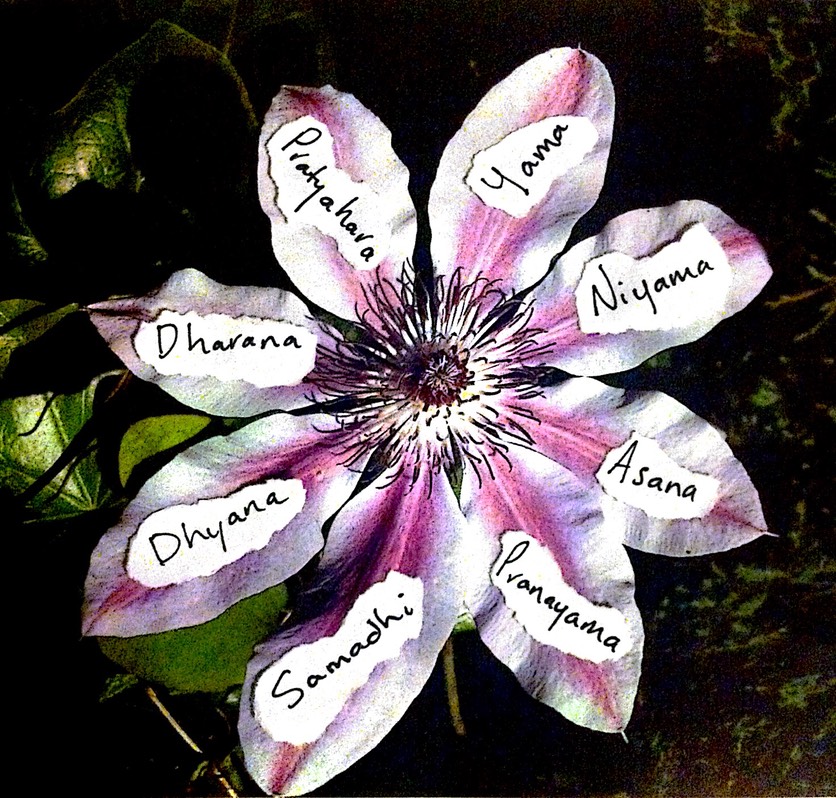
The eight limbs are sequential in the teachings. It makes sense to work on the external stages before the internal stages. However, we can practice and strive for any one of them in yoga practice or everyday living.
The following guide is my understanding of the teachings written with a beginner student in mind. Hopefully, it will help you gain some insight into the ancient teachings of yoga and inspire you to seek out the original texts (and commentaries) as I have done.
THE EIGHT LIMBS
THERE ARE FOUR EXTERNAL STAGES…
1. Yamas can be called the laws of life. However, rather than a ten commandments style of interpretation it is easier to see these as a guide for preserving energy by reducing the complexities in one’s external life.
The five Yamas are; non-violence, truthfulness (honesty), integrity, chastity (non-frivolous sexual activity) and non-attachment (nonpossessiveness).
2. Niyamas are the internal codes of conduct that will free up energy and space from the complexities of everyday living to maintain good physical and mental health.
The five Niyamas are; simplicity, contentment, purification (seeing difficulties as a way of removing our reactionary conditioning), refinement (through self-study or self-awareness) and faith (developing faith in oneself or a higher reality).
3. Asana (Yoga Posture)
The essence of asana is maintaining a COMFORTABLE and STEADY posture – this takes self-awareness and understanding to know if a posture is comfortable enough or not to be beneficial. Another interpretation is that Patanjali is referring to the Asana as a meditation posture, and one should be able to master a still and steady posture that is comfortable and does not distract from the practice of meditation. The practice of yoga postures will aide being able to sit completely still for long periods of time and to be comfortable in doing so.
4. Pranayama (Breathing practices)
These are crucial practices to any yoga sequence and are effective in preparing the mind for the path of meditation to follow. These practices help to quiet the mind and establish a grounding for meditation. The other interpretation of this sutra is the actual cessation of breath (momentary or otherwise). All pranayama practices prepare the practitioner to be able to retain the breath for long periods of time – inside or outside of the body. This practice itself can help restrain the patterns of mind and create a window into the deeper layers of consciousness through a still mind.
…AND FOUR INTERNAL STAGES
5. Pratyahara (withdrawal of the senses)
Sense-withdrawal is an important skill to achieve a good quality of meditation experience. When we are disturbed by our surrounding environment, it is difficult to focus the mind and allow mind patterns to slow into stillness. Many practices in yoga help develop this skill such as; Yoga Nidra (deep relaxation), the first stages of Antar Mouna technique (focussing on sounds, sensations etc), Asana (yoga postures with breath and awareness) and Pranayama.
6. Dharana (concentration or focus)
Dharana is a state of mind that can be established during meditation if there is little or no distractions. Ideally, if the yoga posture is comfortable, the breathing is light and shallow (or even stopping for periods of time), and the senses have withdrawn from the external distractions, then a concentration of mind can be easily achieved. Dharana may be concentration on an inner visualisation, a point in the body or the breath and is usually characterised by a constant and seamless awareness with effort.
7. Dhyana (meditation)
Dhyana is a free flow of continuous awareness. Some say that all the meditation steps before this are not meditation but only preparation for the experience of Dhyana – which is true meditation. Dhyana is where the mind concentrates at one point but the experience is effortless, and the awareness is complete or unbroken. Some describe this as absolute nothingness (i.e., no distraction) and a total stillness of mind.
8. Samadhi (enlightenment or settled mind)
Samadhi is a form of ‘enlightenment’ however there are many levels of Samadhi, and so it may be easier to relate to this state of consciousness as ‘a settled mind.’ Therefore, Samadhi is where the mind and consciousness are totally settled, and the brilliance of mind can be accessed. Skills and talents that remain dormant in some individuals will begin to emerge. Personal insight develops, skills for life develop, and happiness emerges.
Samadhi can seem unattainable. It is important to remember that small aspects of this emerge on a subtle level and permeate your attitudes and approach to life – especially if you practice yoga on a regular basis. These benefits also apply to the other stages as they are practiced and mastered
Hopefully you can gain some insights into the deeper teachings of yoga from what I have presented here. And remember that they are not a step-by-step sequence, they are limbs coming from one source akin to petals on a flower.
Read more about Patanjali at the folowing websites:
Who is Patanjali? – Yoga Journal
22/10/2015




 Maha Farm Australia